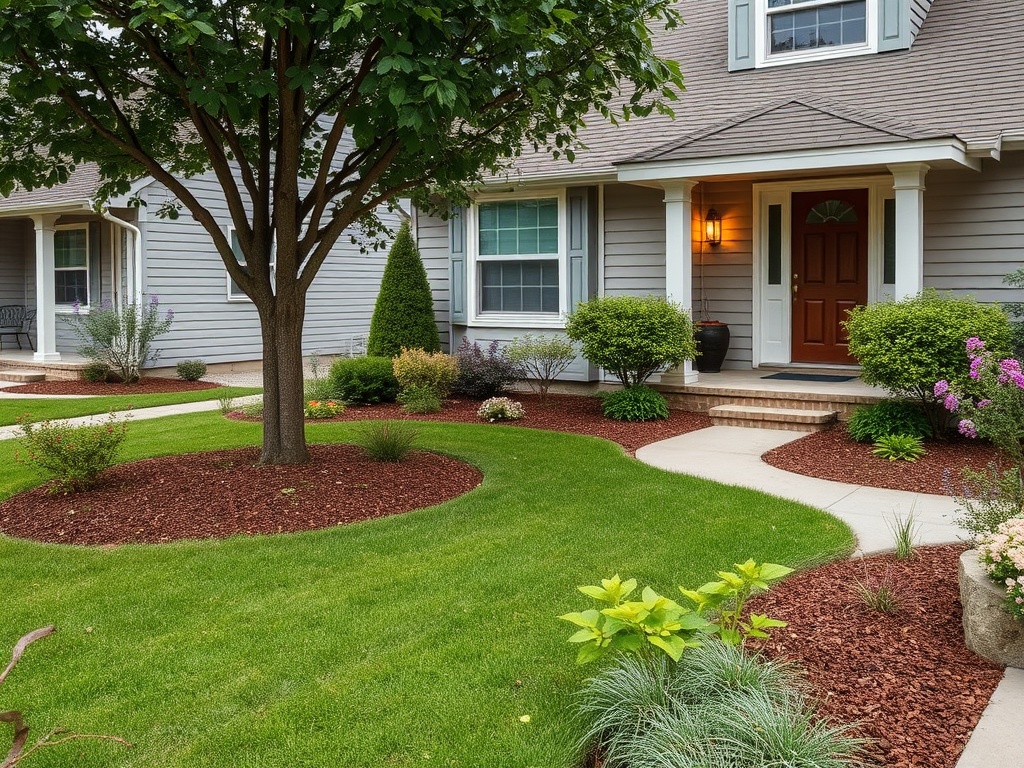
A low-maintenance front yard is designed around the site you actually have: climate, sun, soil, drainage, available water, and the amount of routine care you want to provide. The most durable approach is usually to simplify the layout, reduce high-input areas, choose regionally appropriate plants, and make irrigation and access easy from the start.
TL;DR
Key takeaways
- Define what “low maintenance” means for your household before choosing plants or hardscape.
- Map sun, drainage, slopes, utilities, and existing healthy plants before redesigning.
- Use turf only where it serves a practical purpose and group plants by similar water needs.
- Favor regionally appropriate plants, simple bed shapes, mulch, and efficient irrigation.
- Check local rules before changing drainage, front-yard hardscape, fences, or irrigation systems.
Define the Maintenance You Want to Reduce
Low maintenance can mean fewer mowing hours, less watering, less pruning, fewer seasonal replacements, or less weeding. Those goals are related but not identical. Replacing a lawn with dozens of tightly spaced ornamental plants may reduce mowing while increasing pruning and cleanup. Installing gravel everywhere may reduce plant care but create heat, runoff, or weed problems depending on the site.
Write down the three chores you most want to reduce. Then design around those constraints. If mowing is the main issue, reduce turf. If watering is the problem, choose lower-water plants and improve irrigation. If pruning is frustrating, avoid fast-growing shrubs that must be repeatedly clipped to fit narrow spaces.
Turn those priorities into a phased project rather than a one-weekend makeover so each change solves a clear maintenance problem.
Step 1: Map the Front Yard Before You Change It
Draw the house, driveway, front walk, property edges, downspouts, utility boxes, mature trees, and existing beds. Mark where sun falls in morning and afternoon, where water collects after heavy rain, and which areas dry first.
The EPA WaterSense landscaping guidance recommends matching landscape choices to climate, soil, sun, shade, and maintenance needs. That principle is the foundation of a low-care yard: plants placed in unsuitable conditions usually demand more intervention.
Note slopes carefully. A steep front yard can lose soil and water through runoff, while a low area may stay saturated. If drainage problems affect the foundation, sidewalk, neighboring property, or public right-of-way, a landscape or drainage professional may be more appropriate than a DIY solution.
Step 2: Reduce Turf Strategically, Not Automatically
Turf can be practical for play, pets, visual openness, or a durable walking surface. The goal is not necessarily a turf-free yard but a purposeful one. Keep grass where it is used and where it grows well; convert awkward strips, steep slopes, deep shade, or isolated corners that are difficult to mow.
EPA WaterSense recommends placing turfgrass strategically and considering lower-water species suited to the local climate. If you keep a lawn, the guide on growing a healthier lawn without wasting water can help align irrigation and mowing with water conservation.
Use broad, simple bed curves or straight lines instead of many tiny islands. Simpler edges are faster to mow around and easier to maintain.
Step 3: Choose Regionally Appropriate Plants
Plant selection is where “low maintenance” is won or lost. Favor plants adapted to your climate, soil, available light, mature-space limits, and local pest pressures. Native plants can be useful because they are adapted to regional conditions, but “native” does not mean every native plant belongs in every front yard.
Use the EPA’s plant-selection resources as a starting point, then check your state’s cooperative extension or native-plant database for local recommendations. Confirm mature height and width before planting; a shrub that eventually reaches six feet across should not be squeezed into a two-foot strip beside a walkway.
Use local plant lists to compare ecological fit with the practical needs of a residential front yard.
Step 4: Build a Simple Planting Structure
A reliable low-care composition uses a limited palette repeated across the yard. Start with long-lived structural plants, add a smaller number of flowering perennials or ornamental grasses, and use groundcovers or mulch to cover open soil.
Repeated plant groups usually look more intentional than one of everything. They also simplify care because plants with similar habits can be pruned, divided, or watered on similar schedules.
Avoid planting too close together for an instant “finished” look. Overcrowding can reduce airflow, make pruning harder, and cause neighboring plants to compete as they mature.
Step 5: Group Plants by Water Needs
Grouping plants with similar irrigation requirements into hydrozones can reduce both overwatering and underwatering. Lawn, drought-tolerant shrubs, and moisture-loving perennials should not necessarily share the same irrigation schedule.
Drip or low-volume irrigation can make sense in planted beds when properly designed and maintained. Check emitters periodically, keep lines visible enough to inspect, and adjust watering as plants establish. New plants may need supplemental irrigation even if they are considered drought-tolerant once established.
Water rules and approved irrigation equipment vary by location. Before installing or substantially modifying a system, check local utility guidance and any watering restrictions.
Step 6: Use Mulch Where It Solves a Real Problem
Organic mulch can reduce evaporation, suppress many weeds, and moderate soil temperature. Apply it in planting beds while keeping material away from direct contact with trunks and woody stems.
Do not pile mulch into “volcanoes” around trees. Deep material against bark can hold excess moisture and hide trunk or root problems. Refresh mulch based on actual depth and condition rather than adding a new layer automatically every year.
Rock mulch can work in some arid landscapes, but it is not universally low maintenance. In hot sunny sites it can radiate heat, and organic debris can collect between stones and support weeds over time.

Step 7: Make Hardscape Earn Its Space
A path, landing, or small sitting area can reduce planted square footage while improving how the yard functions. If the front or side yard will include a seating zone, creating an outdoor living room on a budget can help keep that space compact and purposeful. But large areas of impervious concrete can increase runoff and heat. Where appropriate, consider permeable pavers, gravel systems designed for traffic, or spaced stepping stones.
Hardscape must be installed on a suitable base and graded so water moves away from buildings and does not create hazards. Local codes may govern front walks, driveway changes, retaining walls, drainage, or work near the public sidewalk.
Use edging only where it reduces work. A crisp mowing edge between lawn and bed can be useful; decorative borders with many joints may simply create another surface to weed.
Common Low-Maintenance Design Mistakes
The first is choosing plants for their nursery size rather than mature size. The second is creating too many different plant types, each with a separate care routine. The third is assuming irrigation can compensate for poor plant placement.
Another mistake is removing every natural feature and replacing it with hardscape. Low maintenance is not the same as zero living material. A front yard can be simple and resilient while still using trees, shrubs, perennials, and groundcovers where they fit.
Finally, do not ignore access. Leave enough room to reach hose connections, utility meters, windows, gates, and the back of planting beds without stepping on plants.
A Simpler Yard Should Become Easier With Time
A well-planned front yard may require extra work during installation and plant establishment, but routine effort should decline as the landscape matures. Start by mapping the site and identifying the chores you want to eliminate, then make one high-impact change such as reducing an awkward lawn section or simplifying an overgrown bed.
Home and garden information is educational and general. Plant selection, drainage, irrigation, electrical work, structures, and landscape changes can be subject to local climate, utilities, codes, and property rules; consult qualified local professionals when needed.


